Updated monthly · Last reviewed: October 2026
2026 benchmark refresh applied · Last reviewed October 2026
RFP templates, examples, and practical guides
Practical RFP templates and guides: requirement logs, matrix review checklists, go/no-go questions, and how BidOS teams actually run a pack.
Templates that match real artifacts
RFP template searches are informational but they convert when the artifact is one the team will actually use: requirement log, matrix with evidence and owner, go/no-go checklist, review checklist. Generic storyboards do not.
These pages teach the shape. BidosAI produces the filled version after retrieval and review. The existing enterprise playbook URL stays canonical.
Start with locators
A requirement log with document, locator, excerpt, and owner is the cheapest audit on day one. Without it, later cells cannot be defended.
- Requirement extraction and classification — Requirements are split into atomic rows, classified (security, SLA, integration, commercial, delivery), and given stable IDs so later matrix, gap, and plan artifacts point at the same row.
- Compliance matrix autofill — Matched historical answers fill Excel-style response grids. Below the configured similarity threshold, cells stay empty rather than inventing unsupported claims.
- Gap analysis — Unmatched or partial rows become a gap register with evidence paths and remediation notes for solution architects before price is locked.
- Bid planning and WBS — Scope and gaps compile into phased work, roles, and a schedule snapshot. Dates come from planning rules, not from free-form model text.
Requirement log, matrix columns, and review checklist
Log → matrix → gap list → review checklist → export
How to respond without reversing the order
Extract, retrieve, review, then write narrative around the grid. Narrative-first teams discover the real requirements in the last 48 hours. That is the practical guide behind the keyword 'how to respond to an RFP'.
A pretty outline that cannot cite rows will be rewritten on day two.
Checklists that refuse blended scores
Go/no-go checklists fail when a mandatory miss can be averaged away. Review checklists fail when nobody looks at empty cells. Put those rules in the template so the meeting cannot 'green-dot' them.
- Logs that include locators
- Matrices with evidence and owner columns
- Go/no-go sheets that cannot hide a 1
- Playbook traffic still landing on the canonical guide URL
Those are operating measures for a workspace. They are not published customer results.
Lead magnets versus indexed guides
A downloadable matrix workbook can sit behind a form. Indexed guides should still be useful if nobody downloads anything. We will not gate the only explanation of empty-cell policy.
In this cluster
Related topic clusters
- RFP and proposal management software
- AI RFP analysis and requirement extraction
- Compliance matrix and response automation
- Proposal knowledge base and answer reuse
- Bid planning, WBS and effort estimation
- Bid costing and commercial intelligence
- Bid qualification and gap analysis
- Industry-specific RFP solutions
- Competitor and alternative comparisons
Product and research links
Worked example, not a measured result
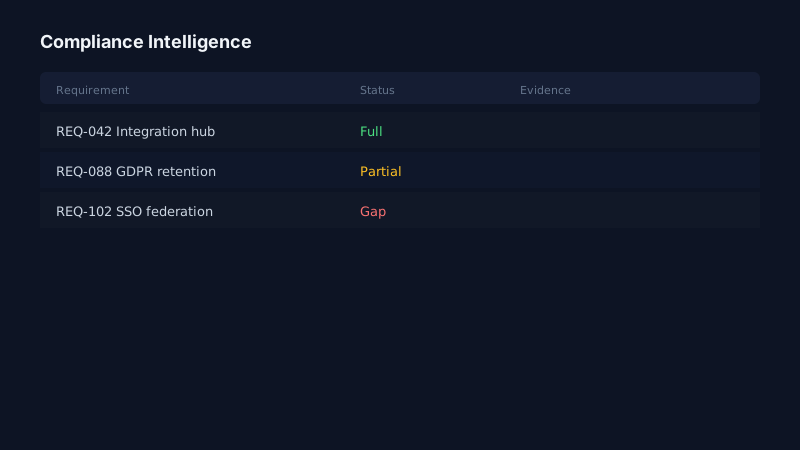
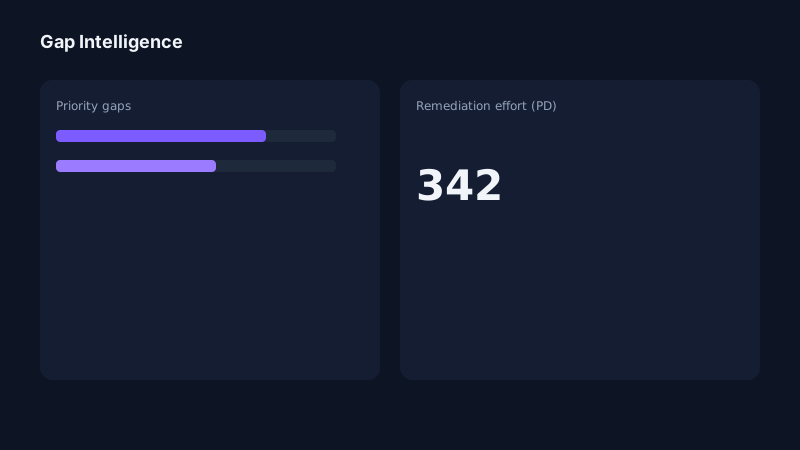
The figures in older drafts of these pages described a fictional cohort. They have been removed. A workspace can show requirements, compliance rows, gaps, and assumptions for a package you upload. That screen is not a statistic about other customers.
Interactive resources
Delivery intelligence flow (expand)
RFP Package → Requirements → Compliance Matrix → Gap/WBS → Commercial Scenarios → Boardroom
ROI & calculators
Bid qualification ROI · Effort estimator · Live demo workspace
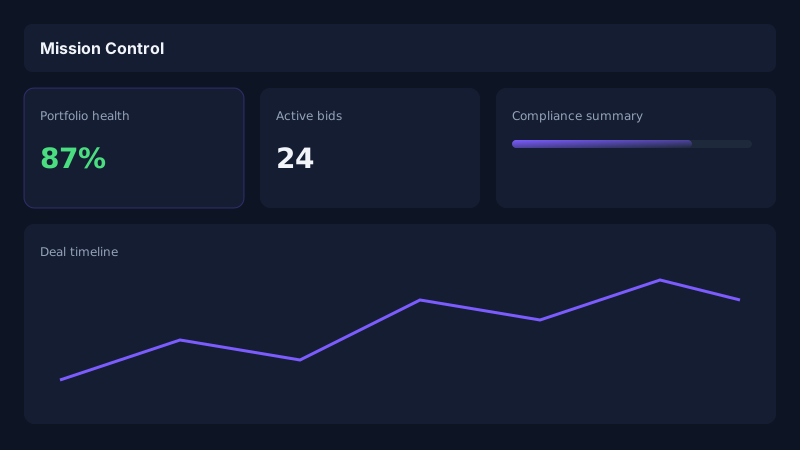
Product tour: Mission Control, compliance, and commercial intelligence — launch demo.
Product evidence

Related intelligence
Frequently asked questions
Are these templates a substitute for the product?
No. They show the shape of artifacts BidosAI produces. Filling them by hand is the process the product is meant to shorten.
Where is the enterprise playbook?
The existing guide URL remains canonical. This hub links to it rather than copying it.
Can we download a matrix workbook?
A compliance matrix workbook is published as a lead magnet where that file exists. Columns should include evidence and owner, not only Yes/No.
Why start with a requirement log?
Without locators, later matrix cells cannot be defended. The log is the cheapest audit you can do on day one.
Is 'how to respond to an RFP' a product pitch?
The process is general: extract, retrieve, review, then write. BidosAI is one way to run that loop with artifacts.
Interactive product tour
Explore Mission Control and compliance intelligence in the public demo workspace — no signup required.
Try Interactive Demo