Updated monthly · Last reviewed: July 2026
Enterprise cohort data 2026 · Reviewed by BidOS Research Team
How to Build a Historical RFP Response Knowledge Base
A practical guide for presales and bid teams: ingest past matrices, govern approved responses, and enable AI retrieval for enterprise RFP reuse.
Why a historical RFP response knowledge base matters
Every enterprise presales organization accumulates thousands of approved compliance answers — yet few can retrieve them at requirement granularity when a new RFP arrives. SharePoint search returns documents, not rows. SMEs remember deals, not cell coordinates. The result is duplicated effort, inconsistent language, and slow cycle times on pursuits you should win faster.
A Historical RFP Response Knowledge Base fixes this by parsing past matrices, bid responses, and Q&A into atomic requirement-to-answer pairs — indexed, governed, and ready for AI retrieval. This guide walks through building that library the way enterprise bid teams actually work.
Step 1: Inventory your artifacts
Start with winning and finalist bids from the last 24–36 months. Prioritize compliance matrices (Excel), issuer Q&A spreadsheets, security appendices, and structured response volumes. For banking and treasury teams, include scheme compliance packs and DR/BCP tables — these repeat most often.
Organize folders by logical taxonomy: industry, product, region, year. BidosAI ingests recursively — folder structure becomes metadata for filtering and future analytics.
Step 2: Govern approved vs draft content
Only approved responses should enter autofill eligibility. Mark draft pursuits clearly; exclude losing bids with outdated product claims. Assign a bid governance owner to review ingestion jobs and retire deprecated rows after major product releases.
Feedback loops complete the model: when presales accepts, edits, or rejects a suggested reuse, the system learns which answers are trustworthy — not merely which are textually similar.
Step 3: Parse and classify
Automated parsers extract requirement text and response text from Excel, PDF, and DOCX. Classification buckets rows into security, availability, integration, regulatory, and commercial categories — improving retrieval when issuers phrase controls differently.
Embedding models (e.g., BGE-small-en-v1.5) capture semantic similarity; BM25 preserves exact regulatory tokens. Hybrid search combines both — critical for compliance reuse.
Step 4: Define confidence thresholds
Exact reuse at ≥97% similarity accelerates repetitive rows. Manual review between 70–90% prevents wrong-fit answers. Below threshold, leave cells empty — never hallucinate. These thresholds are policy decisions; risk-averse banks often raise the autofill bar.
Step 5: Measure and improve
Track match rate, autofill rate, manual review rate, and average retrieval confidence. A mature library should show rising autofill and stable acceptance rates quarter over quarter. Target 1,000+ indexed responses for meaningful coverage on enterprise banking grids.
Diagram placeholder: Knowledge base maturity curve — ingestion volume vs autofill rate over time.
Common pitfalls
- Dumping unreviewed drafts into the library
- Ignoring product version changes after ingestion
- Measuring document count instead of requirement coverage
- Skipping feedback capture on accept/edit/reject
Organizational roles and RACI
Bid governance owners approve ingestion scope. Presales engineers validate parser accuracy on sample rows. Legal and risk review autofill eligibility policies. Proposal managers own accept/edit/reject feedback during live pursuits. PMO tracks metrics: matrix hours, autofill rate, SME load, and disqualification incidents.
Without RACI clarity, knowledge bases become dumping grounds for draft content — degrading autofill trust. Restrict autofill eligibility to explicitly approved artifacts and retire entries after major product releases.
Technology architecture considerations
PostgreSQL stores requirement-response pairs with optional pgvector embeddings. Hybrid retrieval combines BM25, fuzzy matching, and vector similarity. Persistent embedding caches keyed by requirement_hash reduce cold-start cost. Feedback ranking adjusts scores using operational acceptance data — not just cosine similarity.
Evaluate recall@5 on held-out requirement pairs before production rollout. Benchmark exact reuse rate at ≥97% threshold and manual review rate post-autofill quarterly.
Common anti-patterns to avoid
Do not measure success by document count alone — requirement coverage matters. Do not skip feedback capture on accept/edit/reject. Do not allow generative AI to fill cells without retrieval evidence. Do not separate matrix reuse from narrative volumes — inconsistent answers between matrix and proposal body trigger issuer questions.
Interactive resources
Delivery intelligence flow (expand)
RFP Package → Requirements → Compliance Matrix → Gap/WBS → Commercial Scenarios → Boardroom
ROI & calculators
Bid qualification ROI · Effort estimator · Live demo workspace
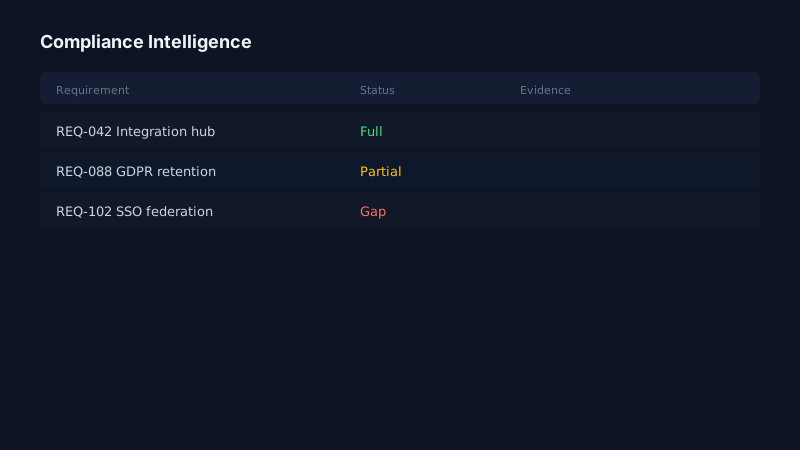
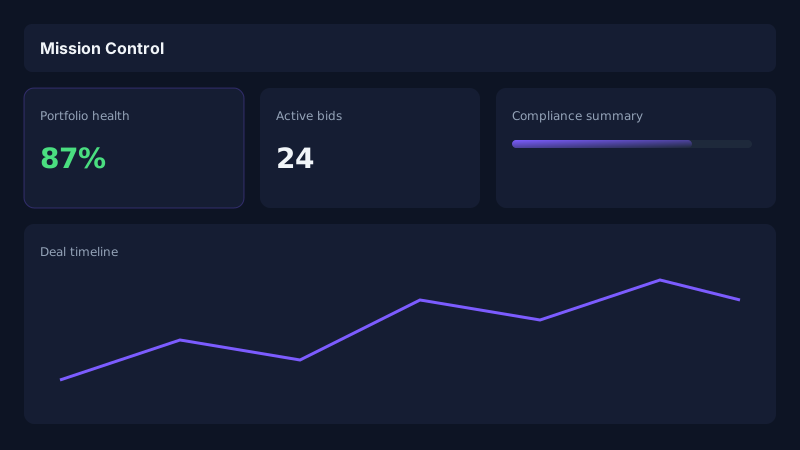
Product tour: Mission Control, compliance, and commercial intelligence — launch demo.
Product evidence
Related intelligence
Frequently asked questions
Who should read this guide?
Presales leaders, bid managers, proposal managers, and compliance owners responsible for enterprise RFP outcomes.
How do I apply this with BidosAI?
Book a demo or open the interactive demo workspace to see historical KB, autofill, and submission workflows live.
Is this vendor-neutral advice?
Principles apply to any mature bid operating model; examples reference BidosAI capabilities where relevant.
Interactive product tour
Explore Mission Control and compliance intelligence in the public demo workspace — no signup required.
Try Interactive Demo