Updated monthly · Last reviewed: July 2026
Methodology panel review · Updated monthly (July 2026)
Project Cost Estimation
Link requirements, WBS, and rate cards into defensible cost baselines. Book a BidosAI demo to see historical RFP reuse, compliance autofill, and submission doc…
Executive summary
Enterprises competing on use case cannot afford fragmented spreadsheets, manual traceability, and late-stage margin surprises. BidOS Project Cost Estimation gives CIOs, bid directors, and delivery executives a single intelligence layer that connects what the RFP demands to what the organization can prove, deliver, and price with confidence.
The enterprise problem
Most organizations treat project cost estimation as a document exercise. In reality, it is a systems problem: requirements arrive across dozens of files, compliance evidence lives in codebases and product catalogs, and delivery leaders discover critical path risk only after commercial sign-off. The result is rework, margin leakage, and executive exposure on fixed-price transformation deals.
BidOS reframes the workflow as an operating system with governed artifacts—atomic requirements, compliance matrices, gap remediation, phased plans, and commercial scenarios—each linked and versioned.
How Project Cost Estimation works in BidOS
1. Ingest & classify
Upload full bid packages. AI document intelligence classifies RFP, security, architecture, commercial, and compliance artifacts, then merges requirement context across sources.
2. Evidence-backed compliance
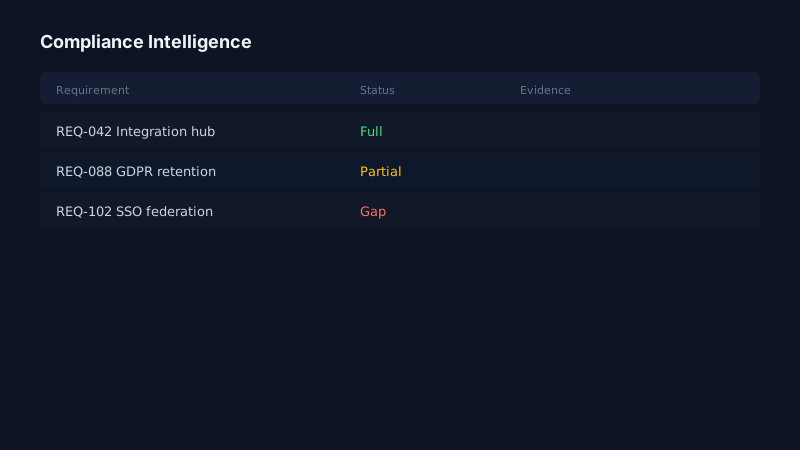
Map each requirement to capabilities with full, partial, gap, and not-matching states. Evidence paths cite modules, APIs, and product intelligence catalogs—not generic boilerplate.
3. Delivery & commercial coupling
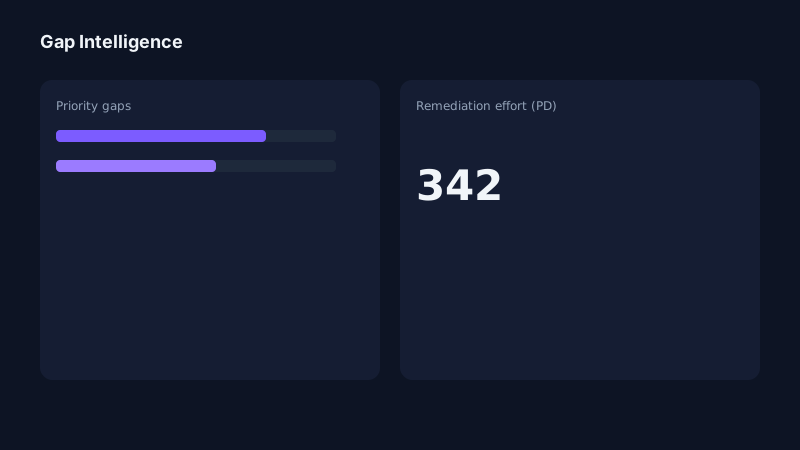
Gaps drive WBS tasks and phased effort. Commercial intelligence stress-tests margin under staffing, timeline, and scope-change scenarios before board review.
Workflow diagram
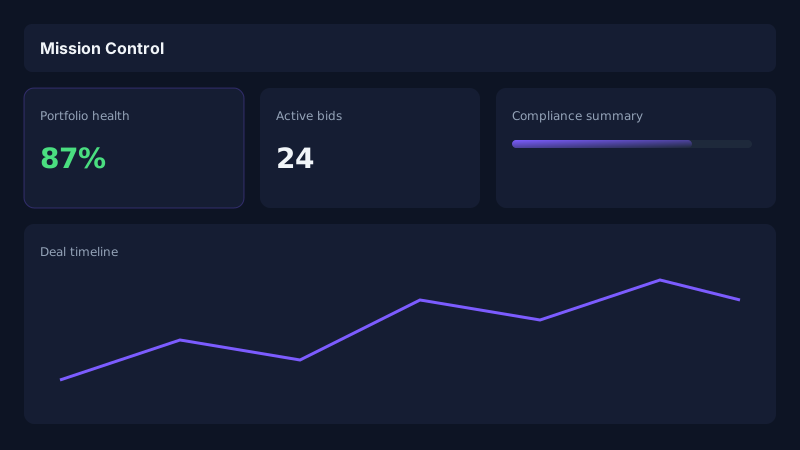
Portfolio health, compliance score, delivery confidence, and commercial readiness in one executive view.
Business impact & ROI
- 30–45% faster bid cycle on multi-document packages
- 15–25% reduction in estimation variance on SI programs
- 8–14 fewer critical gaps discovered post-submission
- 2–4 pts margin protection on fixed-price bids
ROI compounds when compliance, delivery, and commercial teams share one workspace instead of reconciling conflicting models in the final 72 hours.
Technical architecture
BidOS uses a modular pipeline: document conversion (MarkItDown + legacy parsers), requirement extraction and ontology mapping, workspace/catalog resolution, compliance orchestration, deal intelligence, and persisted workspace state. APIs are stateless; intelligence artifacts are stored per tenant with audit events.
Security & governance
Enterprise tenants support SSO, role-based views (presales, architect, delivery manager, executive), optional private deployment, and encryption in transit/at rest. Requirement governance supports lock/unlock with audit for regulated clients.
AI explainability
Every score decomposes into drivers: evidence coverage, classification confidence, merge clusters across documents, and intelligence drift when product catalogs change. Executives see why the system recommends go/no-go—not a black-box probability.
Competitive differentiation
Unlike proposal automation tools, BidOS does not stop at content libraries. Unlike generic SPM platforms, it is purpose-built for bid decisions with compliance and margin guardrails native to the workflow.
Enterprise scenario
An enterprise SI bid with 140+ requirements achieved compliance scoring and phased delivery planning in a single working session using governed workspace intelligence.
Observed outcomes (anonymized cohort)
- 70% faster bid qualification vs manual document review
- 22% improvement in delivery confidence scoring
- 18% better margin visibility before executive approval
Interactive resources
Delivery intelligence flow (expand)
RFP Package → Requirements → Compliance Matrix → Gap/WBS → Commercial Scenarios → Boardroom
ROI & calculators
Bid qualification ROI · Effort estimator · Live demo workspace
Product tour: Mission Control, compliance, and commercial intelligence — launch demo.
Product evidence

Related intelligence
Frequently asked questions
Can we customize ontology?
Requirement classification and governance rules are configurable per tenant and industry vertical.
Is API access available?
Enterprise tiers expose APIs for workspace sync, assessment exports, and portfolio analytics.
What training is required?
Presales leads adopt in hours; delivery and commercial leads align in workshops mapped to your bid gates.
Can executives trust the scores?
Confidence engines expose drivers: evidence coverage, drift flags, estimation lineage, and scenario bounds—similar to portfolio risk dashboards.
How does Project Cost Estimation integrate with planning?
Delivery intelligence, WBS, Gantt views, and critical path modules consume the same requirement and gap graph produced during compliance assessment.
How are hallucinations controlled?
Retrieval is anchored to ingested documents and scanned evidence. Requirements without support remain flagged—not silently invented.
Does BidOS replace Loopio or Responsive?
Document-centric tools focus on response libraries. BidOS is a bid operating system spanning compliance, delivery, commercial, and boardroom intelligence.
Offline or air-gapped?
Enterprise deployments support private cloud and VPC patterns—contact sales for architecture review.
Multi-tenant support?
Each tenant receives isolated workspaces, catalogs, and intelligence metadata suitable for global SI practices.
Pricing model?
Seat and workspace-based enterprise licensing with optional portfolio analytics—see pricing or book a demo.
What is Project Cost Estimation in BidOS?
Project Cost Estimation is a governed intelligence module inside the AI Bid Operating System. It connects requirement evidence, delivery signals, and commercial guardrails so presales and delivery leaders work from one auditable model—not disconnected spreadsheets.
Export formats?
JSON, PDF executive packs, and planner-ready structures for downstream PMO tooling.
Can Project Cost Estimation run on multi-document bid packages?
Yes. BidOS ingests PDF, Word, Excel, and technical specifications in a single orchestrated package with classification, merge logic, and confidence scoring.
How long is implementation?
Most enterprises activate demo tenants in days; production rollout aligns to SSO, workspace mounts, and rate-card masters.
How does Project Cost Estimation differ from generic AI copilots?
BidOS binds each insight to workspace evidence, requirement IDs, and compliance rows. Outputs are explainable, versioned, and suitable for executive review—not opaque text generation.
Who owns the model?
Customer data remains customer-owned; BidOS does not train public models on your bid artifacts without contract.
How is ROI measured?
Teams typically track bid cycle compression, estimation variance reduction, rework avoidance on gaps, and improved margin retention on fixed-price deals.
How does versioning work?
Workspace timelines capture assessment runs, intelligence drift, and deal intelligence versions for audit.
Interactive product tour
Explore Mission Control and compliance intelligence in the public demo workspace — no signup required.
Try Interactive Demo