Updated monthly · Last reviewed: July 2026
2026 benchmark refresh applied · Last reviewed July 2026
Historical RFP Knowledge Base for Enterprise Bids
Build an enterprise bid response knowledge base. Upload past compliance matrices and Q&A; BidosAI reuses approved historical RFP responses with evidence-backed…
Turn approved bid history into a governed response library
Enterprise presales teams answer the same compliance questions in every banking, treasury, and transformation RFP — yet most organizations still store winning responses across SharePoint folders, email threads, and disconnected spreadsheets. BidosAI Historical RFP Knowledge Base centralizes past compliance matrices, bid responses, security questionnaires, and Q&A packs into a tenant-scoped library that AI can search with evidence-backed precision.
Unlike generic document search, the knowledge base is built for requirement-level reuse. Each ingested artifact is parsed into atomic requirements, linked to approved answers, and indexed for hybrid retrieval (lexical BM25 plus semantic embeddings). When a new RFP arrives, BidosAI matches each extracted requirement against your library — surfacing the best historical response with confidence scores, source documents, and acceptance history from prior bids.
Presales leaders gain a single account-level maintenance surface: upload folders of historical artifacts, monitor ingestion progress, review match-rate metrics, and govern which responses are eligible for autofill. Proposal managers keep human control — accepted, edited, and rejected feedback continuously improves ranking without allowing unapproved content into submission packs.
How historical ingestion works
Upload a folder structure mirroring how your team already organizes bids — by client, year, product line, or geography. BidosAI recursively scans Excel compliance matrices, PDF/DOCX RFP packs, and structured Q&A exports. Checksum deduplication prevents duplicate storage; parsing heuristics extract requirement text, response text, and metadata such as product module and compliance category.
Each parsed pair becomes a retrievable record in PostgreSQL with optional pgvector embeddings (BGE-small-en-v1.5 by default). Classification assigns banking-relevant categories — security, data residency, SLA, integration, regulatory — so category-aware boosting improves match quality on recurring patterns like PCI, SOC 2, or core banking interfaces.
Ingestion pipeline
Folder upload → Parse Excel/PDF/DOCX → Dedup + classify
→ Store requirements + responses → Embed + index
→ Ready for hybrid search + autofill
Exact reuse and confidence thresholds
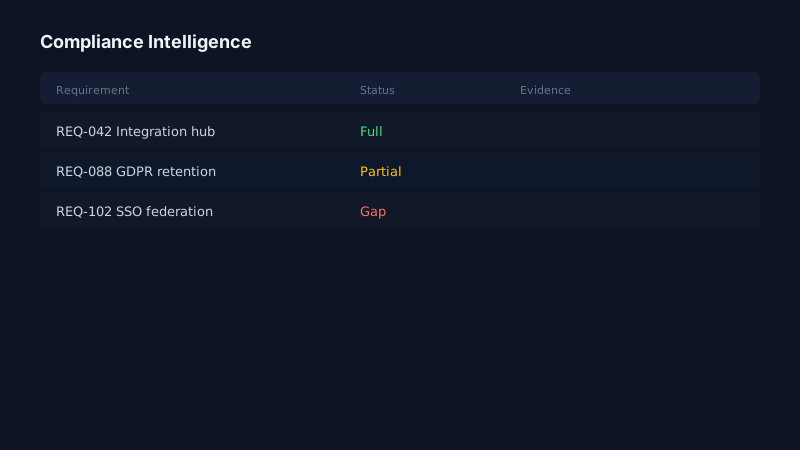
When a new requirement matches an approved historical answer at ≥97% similarity, BidosAI flags EXACT_REUSE — enabling one-click acceptance for truly repetitive compliance rows. Between 70–90%, responses enter manual review with highlighted diffs. Below threshold, the matrix cell stays empty rather than hallucinating an answer: enterprise no-hallucination by design.
Feedback loops matter. Every accept, edit, or reject updates ranking signals (accepted_count, edited_count, rejected_count, last_used_at) so the library learns which responses your presales team actually trusts. Retrieval metrics — average confidence, autofill rate, manual review rate — are visible on the account Historical KB home card.
Who benefits
- Presales engineers — stop hunting last year's matrix for SOC 2 row 214.
- Bid managers — enforce approved language across global practices.
- Banking & treasury teams — reuse scheme, liquidity, and regulatory patterns.
- System integrators — scale compliance libraries across hundreds of pursuits.
Related resources
Building a governed response library at scale
Start by inventorying winning and finalist bids from the last 24–36 months. Prioritize compliance matrices in Excel, structured Q&A exports, security appendices, and narrative volumes that legal has approved. Organize folders by industry, product, region, and year — BidosAI preserves folder metadata for filtering and analytics.
Assign a bid governance owner to review ingestion jobs weekly. Mark draft pursuits and losing bids with outdated product claims as ineligible for autofill. When presales accepts, edits, or rejects a suggested reuse, the system updates ranking signals — accepted_count, edited_count, rejected_count, and last_used_at — so retrieval reflects operational trust, not just textual similarity.
Classification into security, availability, integration, regulatory, and commercial categories improves match quality when issuers paraphrase controls. Embedding models such as BGE-small-en-v1.5 capture semantic similarity while BM25 preserves exact regulatory tokens like PCI DSS, SOC 2 Type II, and RTO/RPO.
Enterprise rollout checklist
- Upload historical artifact folders and validate ingestion checksum deduplication
- Review parser output on sample matrices before enabling autofill
- Configure EXACT_REUSE threshold (≥97%) and manual review gates (70–90%)
- Pilot on one banking or payments pursuit and measure hours saved
- Expand to treasury, core banking, and SI towers after acceptance rates stabilize
Target 1,000+ indexed requirement-response pairs for meaningful coverage on enterprise compliance grids. Monitor match rate, autofill rate, and average retrieval confidence on the Historical KB dashboard.
Integration with compliance autofill and submission
The knowledge base is not a standalone archive — it powers compliance matrix autofill, gap analysis, and submission document generation. Accepted rows export into executive summaries and compliance volumes without a second copy-paste pass. Every external-facing sentence traces to a requirement ID and source artifact for audit defense.
Interactive resources
Delivery intelligence flow (expand)
RFP Package → Requirements → Compliance Matrix → Gap/WBS → Commercial Scenarios → Boardroom
ROI & calculators
Bid qualification ROI · Effort estimator · Live demo workspace
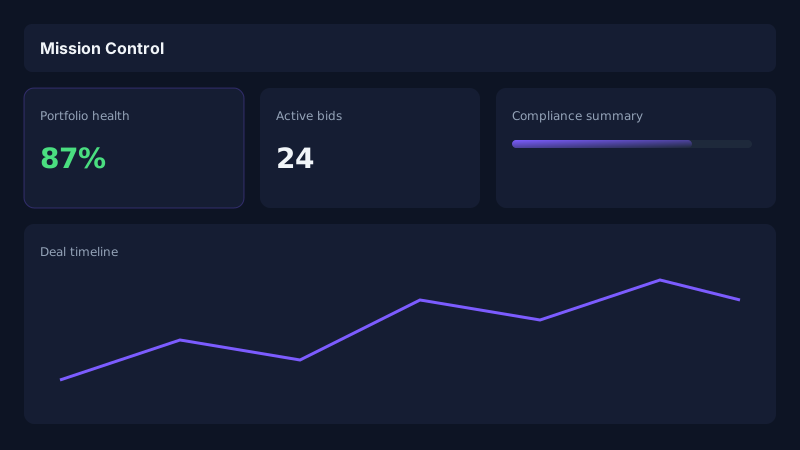
Product tour: Mission Control, compliance, and commercial intelligence — launch demo.
Product evidence
Related intelligence
Frequently asked questions
What is a historical RFP knowledge base?
A governed library of past compliance matrices, bid responses, and Q&A parsed into requirement-level records for AI retrieval and reuse.
How many historical responses can I store?
Enterprise tenants typically index 1,000+ responses. Storage scales with PostgreSQL and optional object storage (GCS).
Does exact reuse require 100% text match?
BidosAI flags EXACT_REUSE at ≥97% similarity with same approved source — accelerating repetitive regulatory rows.
Does BidosAI hallucinate compliance answers?
No. BidosAI uses evidence-backed retrieval from your Historical Knowledge Base. Cells below confidence threshold remain empty rather than inventing claims.
Can I upload past compliance matrices?
Yes. Folder ingestion supports Excel, PDF, and DOCX with recursive scanning and deduplication.
Interactive product tour
Explore Mission Control and compliance intelligence in the public demo workspace — no signup required.
Try Interactive Demo