Updated monthly · Last reviewed: July 2026
Enterprise cohort data 2026 · Reviewed by BidOS Research Team
RFP Automation for Treasury and Payments Teams
Treasury and payments presales reduce cycle time by reusing scheme, liquidity, and regulatory compliance responses across recurring RFP patterns.
Treasury and payments presales share patterns
Liquidity, cash positioning, payment factory, and in-house banking RFPs reuse compliance language across issuers — cut-off times, SWIFT connectivity, sanction screening, pooling rules. Yet teams rewrite these rows because retrieval is document-centric, not requirement-centric.
Automation workflow
Index historical treasury matrices. On new pursuits, autofill high-frequency sections first. Gap analysis flags bespoke treasury policy mappings. Submission generation produces committee-ready packs.
Cross-team consistency
Global treasury vendors benefit from one knowledge base across APAC, EMEA, and Americas — ensuring consistent scheme and regulatory language while allowing regional appendix customization.
Implementation guidance for RFP Automation for Treasury and Payments Teams
Enterprise presales and bid management teams adopt BidosAI in phased rollouts — starting with Historical RFP Knowledge Base ingestion, then enabling compliance matrix autofill on live pursuits. Governance owners define confidence thresholds, retire deprecated product responses after releases, and monitor autofill acceptance rates weekly.
Banking and treasury organizations typically pilot on a single product line with 200+ indexed compliance rows before expanding practice-wide. System integrators centralize winning matrices by tower (application, infrastructure, security) so offshore and onshore teams reuse identical approved language.
Security and legal reviewers participate early: evidence popovers and audit trails matter more than AI branding. Demonstrate source document linkage per matrix cell before scaling autofill to regulated clients.
Proposal managers should define a RACI across presales, legal, risk, and product marketing before enabling autofill on client-facing grids. Without ownership, knowledge bases accumulate draft content that degrades trust and increases manual review load.
Metrics and operating model
Track matrix completion hours, autofill acceptance rate, SME hours per pursuit, manual review rate, and disqualification incidents from compliance errors. Mature BidosAI deployments target 80% faster RFP completion on compliance-heavy grids and 90% reduction in repetitive response writing when 1,000+ historical responses are governed.
Connect BidosAI outputs to executive bid review: gap summaries, compliance coverage percentage, and submission pack readiness should feed steering committees before commercial pricing locks. Human-in-the-loop review remains mandatory — accept, edit, and reject workflows refine retrieval ranking for the next pursuit.
- Index 24–36 months of winning and finalist bid artifacts
- Enforce no-hallucination policy: empty cells beat invented claims
- Integrate gap analysis before bid/no-bid decisions
- Generate submission packs only from accepted matrix rows
- Benchmark recall@5 on held-out requirements quarterly
- Report autofill acceptance and exact-reuse rates to bid PMO monthly
Executive sponsors should inspect trend lines, not single-pursuit anecdotes. A successful program shows rising autofill acceptance, stable disqualification rates, and declining SME hours on compliance rows while win quality remains constant or improves.
Banking, treasury, and payments context
Regulated financial services RFPs introduce controls that repeat across issuers — segregation of duties, PCI and scheme compliance, DR/BCP commitments, data residency, and API security standards. BidosAI category boosting and hybrid retrieval address paraphrased controls without inventing capabilities your product does not possess.
Treasury and payments presales teams benefit from the same knowledge base across regions while tailoring regional appendix language during human review. Consistency reduces issuer clarification questions and accelerates committee approvals.
Why BidosAI differs from generic RFP software
BidosAI is an AI-Powered Enterprise Bid Intelligence Platform — not a document library with AI bolted on. Historical response reuse operates at requirement granularity with hybrid BM25 and embedding retrieval. Compliance autofill attaches evidence to every suggestion. Gap analysis and submission document generation complete the workflow from upload to final package.
Generic proposal tools optimize content collaboration; BidosAI optimizes governed compliance automation with traceability — the decisive difference on banking transformations, core replacements, and payments hub pursuits where unsupported claims carry disqualification risk.
Focus area for this page: rfp automation treasury payments teams — tailored guidance for presales, bid managers, and compliance owners evaluating BidosAI capabilities in live enterprise pursuits.
Book a BidosAI demo to evaluate rfp automation for treasury and payments teams against your current presales operating model.
Interactive resources
Delivery intelligence flow (expand)
RFP Package → Requirements → Compliance Matrix → Gap/WBS → Commercial Scenarios → Boardroom
ROI & calculators
Bid qualification ROI · Effort estimator · Live demo workspace
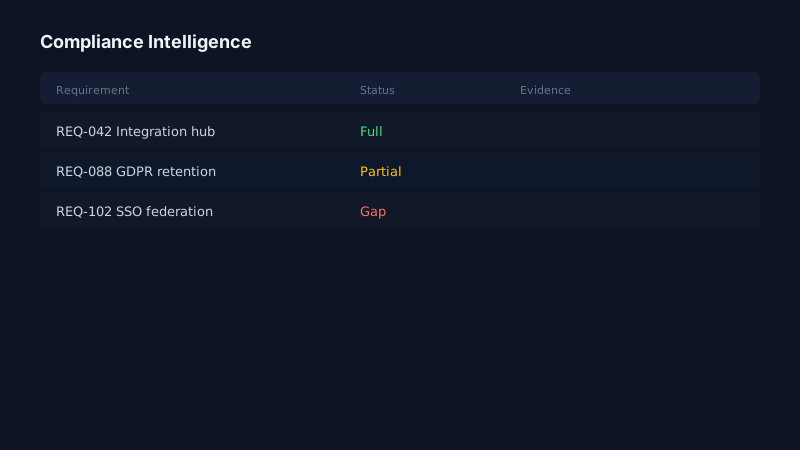
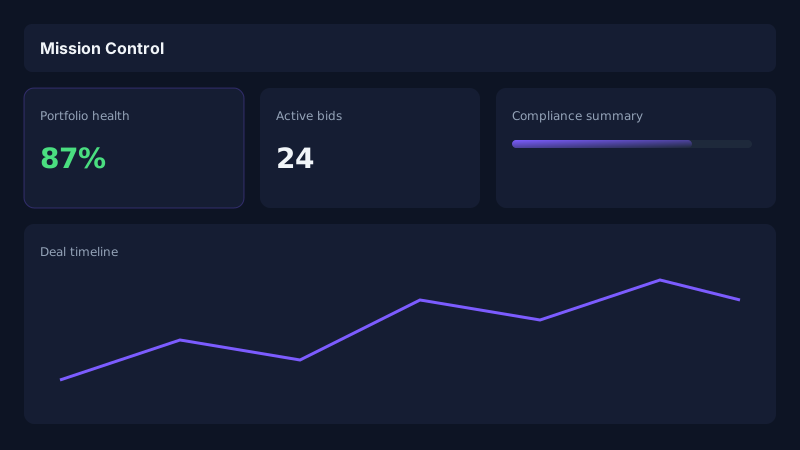
Product tour: Mission Control, compliance, and commercial intelligence — launch demo.
Product evidence
Related intelligence
Frequently asked questions
Who should read this guide?
Presales leaders, bid managers, proposal managers, and compliance owners responsible for enterprise RFP outcomes.
How do I apply this with BidosAI?
Book a demo or open the interactive demo workspace to see historical KB, autofill, and submission workflows live.
Is this vendor-neutral advice?
Principles apply to any mature bid operating model; examples reference BidosAI capabilities where relevant.
Interactive product tour
Explore Mission Control and compliance intelligence in the public demo workspace — no signup required.
Try Interactive Demo