Updated monthly · Last reviewed: June 2026
Methodology panel review · Updated monthly (June 2026)
Banking Identity Platform — Rfp Analysis
Enterprise bid intelligence for banking identity-platform programs: rfp analysis.
Banking Identity Platform — Rfp Analysis
Enterprise bid intelligence for banking identity-platform programs: rfp analysis.
ROI indicators
- 36% faster qualification
- 14% estimation variance reduction
- 9 fewer late-stage gap surprises
Workflow pattern
- Classify multi-document packages
- Score capabilities with evidence paths
- Quantify gap economics and WBS tasks
- Stress-test commercial scenarios
- Publish boardroom-ready narrative
Program context
For regulated financial services, banking identity platform — rfp analysis demands more than keyword-matched proposal text. Procurement teams evaluate banking rfp-analysis against evidence, delivery credibility, and commercial defensibility.
BidOS treats each bid as an operating graph: requirements, compliance rows, gaps, phased effort, and margin scenarios—versioned for audit.
Enterprise scenario
A managed services RFP with 94 SLA clauses mapped to capability evidence with audit-ready lineage.
Practitioner recommendations
- Couple integration-hub spikes to critical-path stress tests before fixed-price approval.
- Version assessment runs when product catalogs change to avoid intelligence drift.
- Publish executive confidence bounds alongside win themes for steering committees.
Benchmark signals
Reference flow
RFP Package → Requirement Graph → Compliance → Gaps/WBS → Commercial → Executive Intelligence
Engagement tools
Use the project effort estimator, bid risk calculator, and ROI suite to validate assumptions before executive approval.
Project effort estimator · Qualification ROI · Open demo workspace
Enterprise scenario
An enterprise SI bid with 140+ requirements achieved compliance scoring and phased delivery planning in a single working session using governed workspace intelligence.
Observed outcomes (anonymized cohort)
- 70% faster bid qualification vs manual document review
- 22% improvement in delivery confidence scoring
- 18% better margin visibility before executive approval
Product evidence

Related intelligence
Frequently asked questions
Is source code required?
Workspace scanning is optional. Compliance intelligence can run against product catalogs, repositories, or documented capability matrices.
Export formats?
JSON, PDF executive packs, and planner-ready structures for downstream PMO tooling.
What about commercial alignment?
Commercial intelligence reads scope, gaps, and phased effort to stress-test margin scenarios before steering committee approval.
Does BidOS replace Loopio or Responsive?
Document-centric tools focus on response libraries. BidOS is a bid operating system spanning compliance, delivery, commercial, and boardroom intelligence.
How does Banking Identity Platform — Rfp Analysis integrate with planning?
Delivery intelligence, WBS, Gantt views, and critical path modules consume the same requirement and gap graph produced during compliance assessment.
Offline or air-gapped?
Enterprise deployments support private cloud and VPC patterns—contact sales for architecture review.
How long is implementation?
Most enterprises activate demo tenants in days; production rollout aligns to SSO, workspace mounts, and rate-card masters.
How does versioning work?
Workspace timelines capture assessment runs, intelligence drift, and deal intelligence versions for audit.
How does Banking Identity Platform — Rfp Analysis differ from generic AI copilots?
BidOS binds each insight to workspace evidence, requirement IDs, and compliance rows. Outputs are explainable, versioned, and suitable for executive review—not opaque text generation.
How is ROI measured?
Teams typically track bid cycle compression, estimation variance reduction, rework avoidance on gaps, and improved margin retention on fixed-price deals.
Can executives trust the scores?
Confidence engines expose drivers: evidence coverage, drift flags, estimation lineage, and scenario bounds—similar to portfolio risk dashboards.
Can we customize ontology?
Requirement classification and governance rules are configurable per tenant and industry vertical.
What training is required?
Presales leads adopt in hours; delivery and commercial leads align in workshops mapped to your bid gates.
Pricing model?
Seat and workspace-based enterprise licensing with optional portfolio analytics—see pricing or book a demo.
Who owns the model?
Customer data remains customer-owned; BidOS does not train public models on your bid artifacts without contract.
What is Banking Identity Platform — Rfp Analysis in BidOS?
Banking Identity Platform — Rfp Analysis is a governed intelligence module inside the AI Bid Operating System. It connects requirement evidence, delivery signals, and commercial guardrails so presales and delivery leaders work from one auditable model—not disconnected spreadsheets.
Interactive product tour
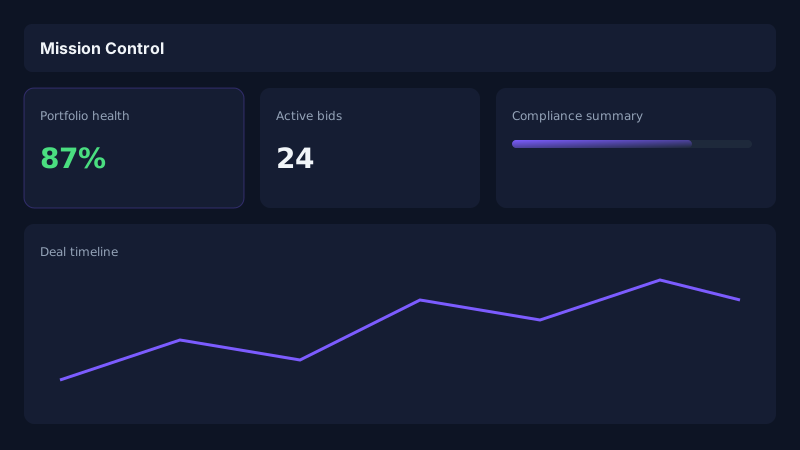
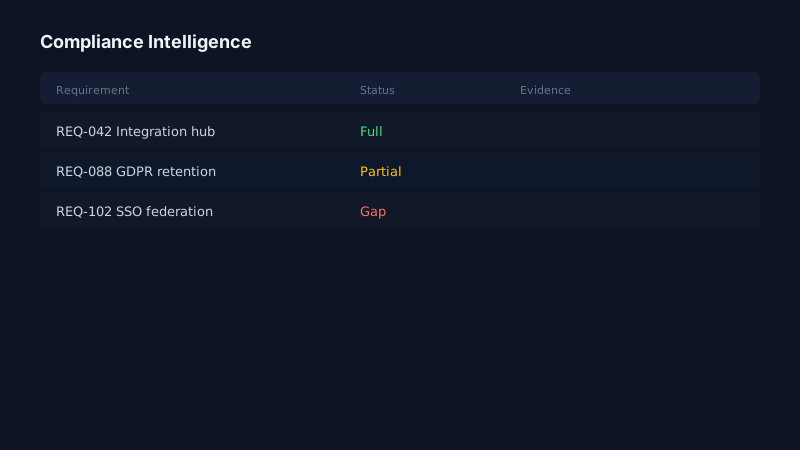
Explore Mission Control and compliance intelligence in the public demo workspace — no signup required.
Try Interactive Demo